
Physical security has traditionally been built around visible boundaries: gates, fences, access points and guarded entrances. These measures remain essential, but they are designed primarily to manage threats approaching at ground level.
Drones challenge that assumption.
They create an approach route that may bypass conventional perimeter measures entirely, giving hostile actors the potential to observe, disrupt or access a site from above. As the technology becomes more capable and widely available, organisations must consider not only who can reach their perimeter, but what can operate beyond it.
A serious warning from Leipzig
On 4 August 2026, a drone equipped with professional explosives and a detonator was discovered at Leipzig/Halle Airport in Germany. The German Federal Prosecutor subsequently took over the investigation, describing the incident as a serious attack on the country’s transport and logistics infrastructure with the potential to affect both internal and external security. Reuters reported the confirmed details of the investigation.
The investigation remains ongoing, and responsibility has not been publicly established. However, the incident demonstrates the potential for a relatively small uncrewed aircraft to create a significant threat within a complex and highly protected operational environment.
It also reflects a wider shift in the European security landscape. The European Commission’s Action Plan on Drone and Counter-Drone Security identifies hostile overflights, airport disruption and risks to critical infrastructure, borders and public spaces as growing challenges. In August, the European Economic and Social Committee again called for stronger preparedness, detection and coordinated response to malicious drone activity.
The UK’s National Protective Security Authority similarly warns that uncrewed aerial systems can facilitate a wide range of hostile activity and may be used to circumvent ground-based protective-security measures.
This is no longer a concern limited to military environments or aviation. It is becoming a wider protective-security and business-resilience issue.
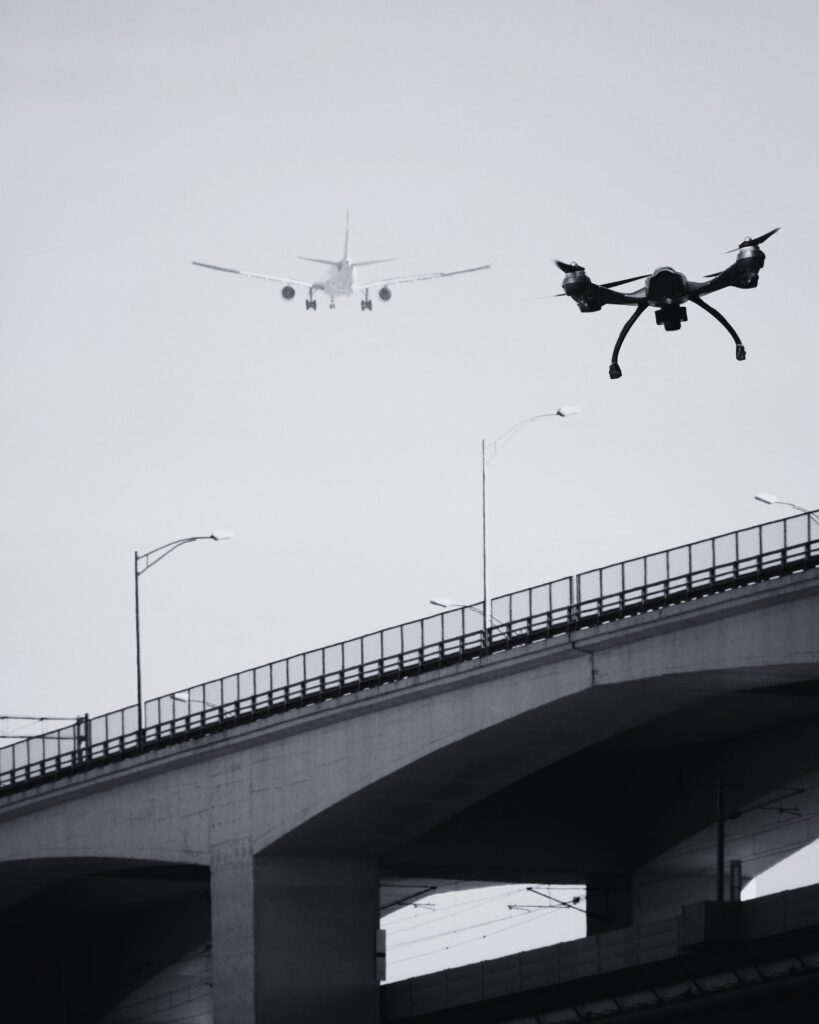
How drones can change the threat picture
Most drone use is lawful and beneficial. Drones support surveying, construction, agriculture, emergency response, media production and infrastructure inspection. Their legitimate presence can, however, make suspicious activity more difficult to identify quickly.
When used with hostile intent, drones may support several forms of activity:
- Hostile reconnaissance: capturing imagery of a site, its assets, security arrangements or patterns of activity.
- Surveillance: monitoring sensitive operations, private locations, high-profile individuals or executive movements.
- Operational disruption: causing shutdowns, delays, evacuations or event interruption, even where no payload is present.
- Unauthorised delivery: moving prohibited, dangerous or disruptive items across a physical boundary.
- Direct attack or sabotage: using the aircraft itself, or a carried payload, to target people, assets or infrastructure.
Drones may also form one element of a broader incident alongside cyber activity, physical intrusion, protest action, disinformation or other forms of disruption. The aircraft overhead may be the most visible element, but not necessarily the only one.
Corporate exposure extends far beyond airports
The relevance to corporate security is clear. Logistics hubs, energy facilities, ports, data centres, industrial sites, major events, corporate estates and private residences can all present attractive targets for observation or disruption.
The impact does not depend on an attack being completed. A single unidentified drone can interrupt operations, create uncertainty among staff, trigger an emergency response and generate reputational concern. Poorly coordinated decisions can then increase the disruption.
This means drone risk sits across several areas at once: physical security, safety, privacy, crisis management and business continuity. Treating it as an isolated technology issue can leave important gaps between the teams responsible for each.
Preparedness must come before detection
Technology can play an important role in identifying and assessing drone activity, but an effective response cannot be built around equipment alone. Not every sighting is hostile, and any intervention must operate within the relevant legal and aviation framework.
Organisations should begin with a clear understanding of their own exposure and an agreed response structure. Key considerations include:
- Assess aerial vulnerability. Identify what could be observed, accessed or disrupted from above and which people, assets and operations would be most affected.
- Understand normal activity. Record authorised drone operations and establish how expected activity will be distinguished from something unusual.
- Create clear reporting procedures. Staff should know what to report, who receives that information and when an incident must be escalated.
- Define roles and decisions. Security, operations, safety, communications and senior leadership should understand their responsibilities before an event occurs.
- Integrate continuity planning. Response plans should consider how essential activity will be maintained if part of a site is restricted or operations are suspended.
- Train and exercise. Scenario-based exercises can expose gaps in communication, decision-making and coordination before they are tested by a live incident.
- Coordinate with the appropriate authorities. Reporting routes and external relationships should be established in advance, particularly for higher-risk sites and events.
The objective is not to treat every drone as an attack. It is to give personnel the awareness and structure needed to recognise abnormal activity, respond proportionately and protect operations while the situation is assessed.
“Preparedness does not begin when a drone appears overhead. It begins with understanding the risk before an incident occurs.”
Looking above the perimeter
The Leipzig/Halle incident is a reminder that protective security must continue to evolve alongside the threat. Gates, guards and access controls remain fundamental, but they are no longer the complete picture.
At Greyedge Protection, we help organisations understand changing risks through intelligence-led threat and vulnerability assessments, hostile-reconnaissance awareness, operational planning, training and scenario testing. By considering aerial exposure alongside existing physical-security arrangements, organisations can develop clearer escalation procedures, stronger coordination and more resilient operations.
Preparedness does not begin when a drone appears overhead. It begins with understanding the risk before an incident occurs.
Prepared. Precise. Proven.
To discuss your organisation’s security and risk-management requirements, contact Greyedge Protection at greyedgeprotection.com.